
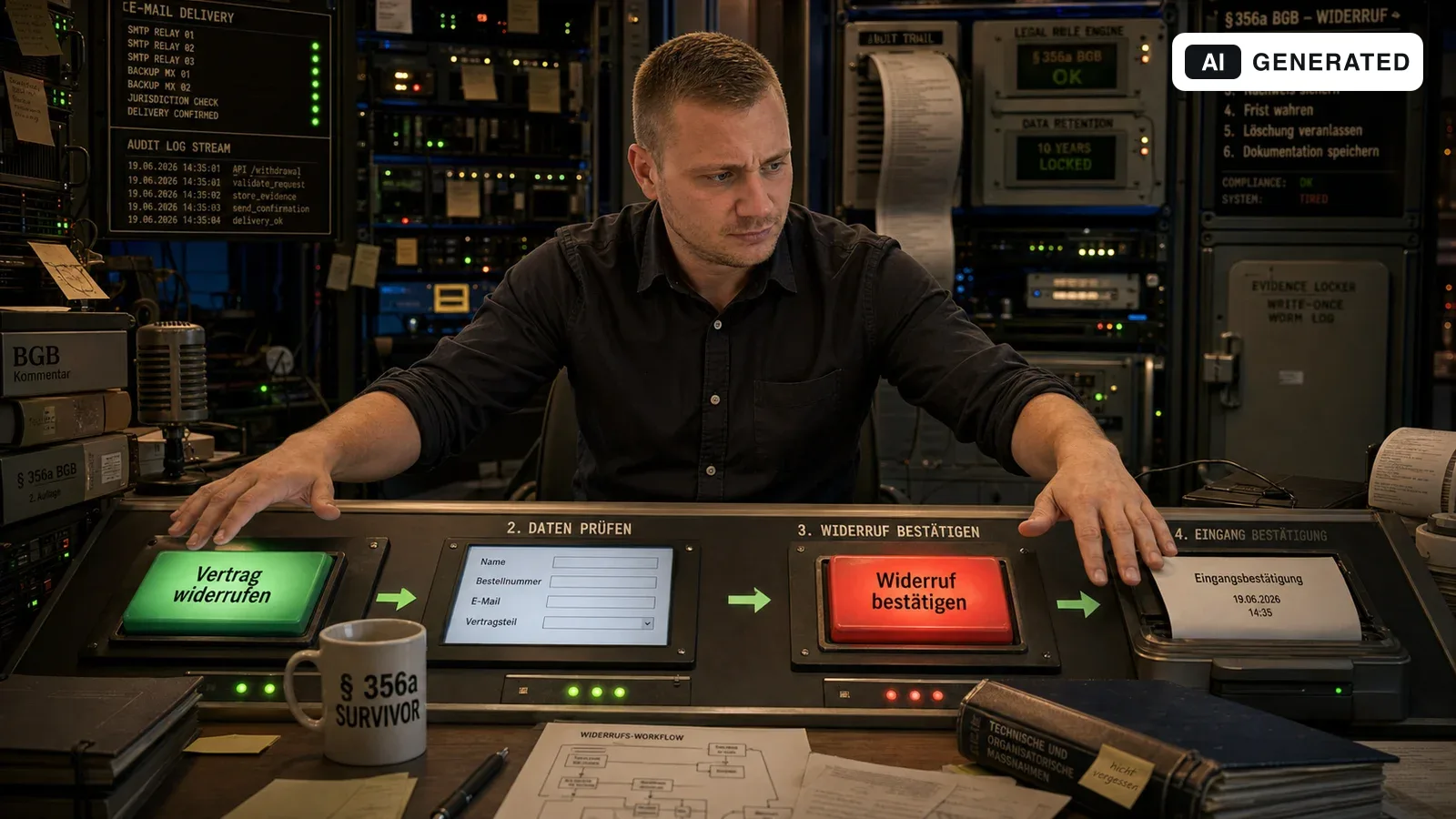
The essentials in 60 seconds / tl;dr
- The reform does not create a new withdrawal right. It adds a mandatory online route for exercising an existing statutory right.
- It concerns consumer distance contracts concluded through an online interface where a statutory withdrawal right exists.
- The first function says “withdraw from contract” or an unambiguous equivalent. Required details are followed by a second “confirm withdrawal” function or equivalent.
- Submission must be followed without undue delay by an acknowledgement on a durable medium, containing at least the declaration, date and time.
- Withdrawal information, guest orders, marketplaces, partial withdrawal, accessibility, email delivery and logging belong in one implementation plan.
Short on time?
01
The withdrawal right is not new; the mandatory digital route is
The reform is sometimes described as a new EU regulation. More precisely, Directive (EU) 2023/2673 amended the Consumer Rights Directive and required Member States to introduce an electronic withdrawal function. Germany implemented it, in particular, through section 356a BGB, applicable since 19 June 2026.
The existing principle remains: a consumer can withdraw from a contract covered by a statutory right through an unambiguous statement, without giving reasons. The electronic function is an additional route; email, letters and the model form remain available.
The EU objective is to make withdrawal from an online contract similarly easy to concluding it. Despite the amending directive’s title, the function is not limited to financial services and generally extends to distance contracts covered by the Consumer Rights Directive.
02
Four questions determine whether section 356a BGB is relevant
“Every online shop needs a withdrawal button” is too broad. Four conditions should be considered separately.
Consumer contract
The contract is between a trader and a consumer. A purely B2B checkout is not covered by this provision merely because it is online.
Distance contract
Negotiation and conclusion take place exclusively at a distance within an organised distance-sales system.
Online interface
The particular contract is concluded through a website, app or other software interface. A contract concluded exclusively by telephone does not meet this condition.
Existing withdrawal right
A statutory right exists for this contract and has not been excluded or validly expired under the applicable rules.
| Example | Initial view | Reason |
|---|---|---|
| Standard B2C goods purchase online | Function generally required | A distance contract through an online interface with no apparent statutory exception. |
| Pure B2B shop | Section 356a generally not applicable | The rule attaches to a consumer contract. |
| Order placed exclusively by phone | No duty under section 356a | The contract was not concluded through an online interface. |
| Online contract without a statutory right | No function for that contract | The function presupposes an existing right. |
| Sale through an online marketplace | Ensure availability | The official memorandum keeps the contracting trader responsible even where a third party operates the interface. |
Businesses combining B2B and B2C, tickets and goods, or multiple sales channels therefore need a reliable classification by contract and checkout rather than one global yes-or-no setting.
03
Exceptions remain exceptions: mixed ranges need careful modelling
Section 312g BGB lists contracts for which no statutory right exists. Other rights may exist initially and later expire under section 356 BGB. The new function does not alter that structure.
Personalised goods
Goods made to the consumer’s individual specifications may fall within the exception. A standard choice of colour or configuration is not automatically sufficient.
Perishable or unsealed goods
Rapidly perishable items and certain sealed health or hygiene goods after unsealing may be excluded.
Time-specific leisure services
Leisure services are excluded where a specific date or period is agreed. This is relevant to many concert, theatre and event tickets.
Services and digital content
An initially existing right may expire early, but only where the specific statutory conditions, such as express consent and acknowledgement, are met.
Example: ticket shop with merchandise
A concert ticket for a fixed date generally has no statutory withdrawal right under section 312g(2)(9) BGB. A standard, non-personalised fan item sold in the same shop may still be withdrawable. The shop, order data and flow must be able to distinguish these contract parts.
The function should not automatically be removed merely because the trader assumes the period has expired. The official memorandum permits general availability where calculating each individual period would require disproportionate effort.
04
The statutory journey contains two deliberate steps
Section 356a BGB requires more than a contact page. The first function opens the declaration; a second, clearly labelled confirmation function submits it.
“Withdraw from contract”
The clearly legible first function, or an unambiguous equivalent, opens the flow.
Identify the contract
The form needs the consumer’s name, details identifying the contract or part, and the electronic means for the acknowledgement.
“Confirm withdrawal”
The second function submits the declaration and protects against withdrawal by a single accidental click.
Acknowledge receipt
Without undue delay, an acknowledgement on a durable medium follows with the declaration, date and time.
Where several goods or services are covered, the declaration must identify the contract or part being withdrawn. An order overview with selectable line items is one practical approach.
Receipt is not the same as a validity decision
The automated message should document receipt without unintentionally declaring every legal requirement satisfied. The official memorandum recommends separating acknowledgement from any later assessment of validity and scope.
05
Easy access means more than a link hidden in legal small print
The statute requires continuous availability throughout the withdrawal period, prominent placement and easy access. It does not prescribe one exact position such as the footer.
The official memorandum adds practical detail: the function should be directly reachable from every subpage, for example through a clearly recognisable link. In a footer it should stand out from terms, imprint and other information through contrast and placement.
Guest orders must not be blocked by later registration. As a rule, access should not require a login. The memorandum considers a login-only location sufficient where the contract itself could only be concluded with an account.
- findable on desktop and mobile without searching
- clear German or appropriately localised wording
- keyboard-accessible with visible focus
- no unnecessary registration, authentication or app installation
- usable for guest orders and expired sessions
- errors explained without losing the declaration
Prominent placement, legibility and easy access are part of section 356a itself. Depending on the service, broader accessibility requirements for digital services must also be considered.
06
Withdrawal information and contract communications also need updating
Article 246a section 1 EGBGB now also requires, where applicable, information about the existence and placement of the withdrawal function. A technically correct function alone therefore does not satisfy the information duty.
The official model includes a new drafting instruction with an internet address or other suitable indication of where the function is available. It also describes the acknowledgement containing the declaration, date and time.
Businesses using the statutory model should not append an improvised sentence without reviewing the whole notice. Contract type, return costs, early performance, digital content and exceptions can affect the complete information.
Update together
- withdrawal information and related terms references
- checkout and contract confirmation
- footer, help area and account navigation
- acknowledgement email template
- privacy information for new processing and logs
- support instructions and internal review process
07
Withdrawal, returns and termination are not the same
Several processes are mixed in everyday language but should be modelled separately.
Withdrawal
Exercises the statutory right for a contract or part. The declaration must be unambiguous but needs no reasons.
Return
Organises the shipment of goods back to the trader. A return label may support the process but does not automatically replace the required function.
Termination
Ends an ongoing relationship for the future. Section 312k BGB provides a separate termination button for certain continuing contracts.
Cancellation
Often describes a voluntary or contractual option offered by the trader, for example for tickets. It is not automatically statutory withdrawal.
08
A reliable withdrawal journey does not end in the frontend
A robust implementation joins interface, contract data, evidence and operations. The following is technical guidance, not an additional statutory form requirement.
Interface
Prominent entry, understandable form, selectable items, a second confirmation step and accessible error handling.
Contract matching
Order number, name and a suitable identifier match the declaration without collecting unnecessary data. Authenticated users should not repeat known information.
Reliable evidence
The server records content, timestamp, contract parts, delivery channel and processing status in a traceable way.
Notification
The acknowledgement is generated without undue delay and delivery is monitored. Failures need retry logic and an internal alert path.
Operational follow-up
Refunds, returns, compensation, digital access or manual assessment follow as separate states. Receipt must not disappear because a later step fails.
Quality assurance
Tests cover guest orders, accounts, partial withdrawal, mobile, keyboard, expired periods, email failure and repeat submission.
Go-live checklist
- inventory all B2C contract types and statutory exceptions
- clarify responsibility for marketplaces and third-party checkouts
- label both functions unambiguously
- support partial withdrawal and mixed orders
- test guest access, mobile, keyboard and screen readers
- test acknowledgement content, date and time
- update withdrawal information and destination link
- add monitoring, logs and support escalation
09
Frequently asked questions
Has the rule really applied since 19 June 2026?
Yes. The directive required Member States to apply implementing measures from that date, and section 356a BGB is now in force in Germany.
Must the wording be exactly “withdraw from contract”?
That is the wording named by the law. An unambiguous equivalent is permitted, as it is for “confirm withdrawal”. Vague service or contact language is not a robust choice.
Is the model PDF enough?
No. For covered contracts, section 356a requires an online function through which the declaration can be sent and electronically acknowledged. The model form remains an additional route.
Can it exist only inside an account?
According to the official memorandum, generally only where the contract could itself be concluded only with an account. Guest orders should remain withdrawable without new registration or login.
Do event tickets need the function?
Leisure services for a specific date or period generally have no statutory withdrawal right under section 312g(2)(9) BGB. Other goods in the same shop may be treated differently.
Must a late declaration be accepted automatically?
The function first records the declaration. Timeliness and substantive validity can be assessed afterwards. General availability does not itself mean a right exists in every case.
What are the consequences of a missing function?
Article 246e section 1 EGBGB treats a missing or non-compliant function and missing acknowledgement as an infringement of consumer interests. Consequences in a particular case require qualified legal advice.
10
Official sources and legal basis
This article relies on current German legislation, the underlying EU directive and official legislative materials. Vendor and commentary blogs were not used as legal authority.
- Directive (EU) 2023/2673, particularly Article 11a and recitals 36-39
- Section 312 BGB: scope of consumer contract rules
- Section 312c BGB: distance contracts
- Section 312g BGB: withdrawal right and exceptions
- Section 355 BGB: withdrawal from consumer contracts
- Section 356 BGB: start and expiry of the right
- Section 356a BGB: electronic withdrawal function
- Section 312k BGB: online termination of consumer contracts
- Article 246a section 1 EGBGB: information duties
- Annex 1 EGBGB: official model withdrawal information
- Article 246e section 1 EGBGB: enforcement of consumer interests
- Bundestag paper 21/1856: government bill and explanatory memorandum
- German Bundestag: legislative resolution of 19 December 2025
11
Does my offer need a withdrawal function?
Free two-minute check
This short check covers only the basic conditions. It stores and transmits no answers and cannot resolve exceptions or individual cases.
No email · No registration · Runs only in your browser
This article provides general information and is not legal advice. Whether and how the function must be provided for a particular product range, marketplace or contract should be assessed by a qualified professional where necessary.